The project

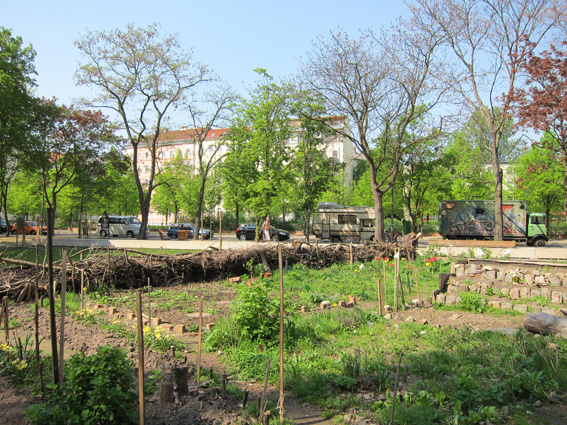
Referring to the unofficial twinnings that reflect Berlin’s current immigrant population instead of the official equivalents of the city, the project explores the city’s long tradition of urban horticulture and reveals ideas of health in the widest sense: as balance and imbalance as well as on a societal and personal level, looking at how people navigate and share resources within a city.

Visualizzazione post con etichetta beans. Mostra tutti i post

domenica 21 agosto 2011

Bean | Phaseolus vulgaris, Fabaceae

Gayle Chong Kwan, Bean, collage, 2011

Beans are one of the longest-cultivated plant and are a very significant source of protein throughout the world as they have significant amounts of fibre andre. This can help lower blood cholesterol. Beans are also high in complex carbohydrates, folate and iron.


We cultivate all kinds of herbs, such as basil, parsley, chives, marjoram and savory, though mainly we plant French
beans. Ilona Gross, Waldland, Bezirksverband der Gartenfreunde Berlin-Treptow e.V.
 

Parsley is used in almost all dishes and for soups, whilst savory is essential for French bean soup. 
Ilona Gross, Waldland, Bezirksverband der Gartenfreunde Berlin-
Treptow e.V.


My father moved from Columbia to Berlin almost 20 years ago and we got the garden just two years after we applied for it. We have a lot of beans over here, plus herbs, carrots and basilicum. I like
to spend my time in the garden studying and playing music with my friends even if we are the only ones of our ages. The
others are mostly older, more of my parents’ age. They know and meet a lot of people here in the colony, though some can be a little bit conservative and a little strange with immigrants and
homosexuals. Some of them are the ones with the German flag waving on their plot, but not all of them. The others are
just proud to be German. 

Anna Paulina Solano Miller, POG, Bezirksverband Charlottenbu
rg der Kleingärtner e.V.
 

The garden opened in 2004 or 2005 but we got our little plot only last year. I had just had my baby and I had a lot of free time, so we decided to start cultivating. We have different kinds of
beans, strawberries, potatoes, beetroot and some herbs… All vegetables are healthy. It is great to have a green oasis
inside the city. I grew up in the suburbs of Berlin where there are a lot of green areas and I missed them. 

Hana Gunkel, Bürgergarten Laskerwiese e.V.
 

Japanese consider it very important to have 30 different kinds of food every day. The government encourages the nation to have lots of different foods, to keep a balance between vitamin C and proteins, carbohydrates and fat. I learnt at school that each food is
categorised into 5 or 6 groups, like fish or meat, or beans or milk, and the government says that having these different types of food everyday is ideal.
Miki Ito, Hand in Hand, Bezirksverband Berlin- Süden der Kleingärtner e.V.
 

When bean stew gets burnt, put the pan, with the lid on, in cold water for about 10 minutes. Then put the food in another pan and season accordingly.
Margrit Kissling, Waldland, Bezirksverband der Gartenfreunde Berlin-Treptow e.V.

lunedì 9 maggio 2011

I like to spend my time in the garden studying and playing music with my friends

Paulina with some friend playing music in her allotment

My father moved from Columbia to Berlin almost twenty years ago and we got the garden just two years after we applied for it.  We have a lot of beans over here, plus potatoes, carrots, cherries, basilicum, melissa and camomille. I like to spend my time in the garden studying and playing music with my friends even if we are the only ones our ages. The others usually are older, mostly my parents' age. They know and meet a lot of people here in the colony, though some can be a little bit conservative and a little strange with immigrants and homosexuals. Some of them are the ones with the German flag waving on their plot, but not all of them. The others are just proud to be Germans.
Anna Paulina Solano Miller, German-Columbian, POG, Bezirksverband Charlottenburg der Kleingärtner e.V.

martedì 3 maggio 2011

A nice walk in Bürgergarten Laskerwiese e.V.

Hana Gunkel and Andreas Pfenning working of their parcel

view of the supermarket

We have almost twenty parcels in the garden. Some of them are cultivated by just one or two people, then we have a big one that is cultivated by a house community of 8 people. We are like 30 members, I think, very different in ages but not in provenances. Even if this is supposed to be an intercultural garden, we have just one person from Turkey and another one from Argentina. Every second saturday in the good season we have community gardening as we have many community areas that are cultivated by all the people together and we do also have connections with other urban gardenings in the city. So I could learn a lot about cultivating as when we got the plot we knew almost nothing, but the neighbours gave us suggestions. I think this would not happened in a kleingaerten where everybody has its private and fenced parcel. They are really "private" places.

their proud baby

other parcels

Andreas and his baby

behind ostkreuz

There is a dogs area around here, so often it happens that dogs come in and shit everywhere. We had to plants some aromatic plants that dogs do not like to keep them away but besides this, sometimes it happens that also few young guys come in and destroy some areas as this still remain a public space and everybody can come in.

many people live around the area

the water is collected from the roof of the supermarket

The garden openend in 2004 or 2005 but we got our little plot just last year. I had just got my little baby and I had a lot of free time so we decided to start cultivating. We have different kinds of beans, strawberries, potatoes, , beetroots and some herbs... all vegetables are healthy. It is great to have a green oasi inside the city. I grew in the suburbs of Berlin where there are a lot of green areas and I missed them.

the family

cauliflowers

the pond is a community area
A neighbour of ours did not have so much time to look after his plot, so when he came again after weeks he found it completely invaded by calendula and he has a little child so when he saw his plot he just sayd: "Oh, we have calendula!". And he used it everywhere, for tea, oil, oinment... giving it to his child.

a place to play


Hana Gunkel, German, Bürgergarten Laskerwiese

domenica 1 maggio 2011

A day cooking with giulia and Husniye Ozturk

ton steine gaerten

not just a bench

springtime

tulips

savory

preparing the ingredients

for a Gruene Bohnen Eintopf

bohnen and onions

two of us

onions and bohnen again

overview at ton steine

some parcels

Husniye Ozturk

behind the stage

giulia and Husniye Ozturk

making a video

and waiting for the lunch

it's almost ready

last frame

Gruene Bohnen Eintopf (French Been Stew):


2 red onions, 2 tomatoes,
500 gr turkish green beens (short and flat),
oil, salt.

Clean the green beens.
cut the onion and tomatoes in cubes.
In a big plate mix onions, tomatoes and beans.
Put salt.
Put the pot on the fire and add some oil , than add the vegetables.
add hot water nd cover the pot.
cook for about 20 minutes turning sometimes the stew.

  1. In a skillet over medium high heat, melt butter and add rice, stirring and cooking til golden.
  2. Add soup mix, then stir in water.
  3. Simmer, covered, for 20 minutes or until water is absorbed and the rice is tender.
  4. Add turkey and heat through.
  5. Serve, if desired, with coconut, chopped peanuts, raisins or chutney.

lunedì 11 aprile 2011

Prinzessinnengarten


Other students and I with my family opened this place in July 2009. I wanted to become a father and have a job where I had not to work too much and could bring my kids with me. So, after living few years in Cuba, that has a very intense model of urban agricolture, I tried to do quite the same in Berlin. We cultivate all the different kind of vegetables you find in the supermarkets, but we use organic seeds to show our children how they grow and how better they are. Then we try to have a huge variety of kind for each vegetable. So we have 15 kinds of potatoes, 20 different kinds of tomatoes, 7 different kinds of carrots, 25 different kinds of ments, and some exotic things like 6 cm long beans from Africa. Some of the old women got cultural connections growing vegetables when they where young in Russia or Turkey or somewhere else. They have brought seeds or even plants with them from there, which they knew from their past, and which they wanted to have here as kind of piece of home. Many people have Turkish, Danish, French, American, English, Palestinian, Arabic, Indian, Swedish or Iraq ancestors. We have a very open system, so you do not have to become a member to partecipate.
Robert Shaw, British-German


In Germany we are not aloud to cultivate and sell herbs for medical purpose, so we do not cultivate any kind of these but we have got some things which are more for health. If you got a cough you can take a thyme tea or we have healing plants like comfrey.
Robert Shaw, English-German


Indigenuous people use some bushes for their health, but I do not know them. The same for our Chineses immigrants that have many traditional medicines using plants. However when I am sick I take fresh honey, ginger and garlic. They make me feel better.
Emma Rugg, Australian


We have rugbrød that is a very dark bread which is very healty because it is rich in whole grain and dietary fiber and contain little or no sugar, and is thus considered by many Danes as a healthy alternative to whiter types of bread. I never tried to bake it myself because it is a very long process, but my father does and it is always nice to come home and have the homemade smørrebred.

Ida Davidsen, Dane


I could find mangos in Berlin or kiwi from New Zeland, however they are not very fresh and it's not very good for the enviroment to buy foods that have been travelling half the world. So I do not like to buy them.
Emma Rugg, Australian


There is a popular Australian story that became a cartoon where a little koala - Blinky Bill - eats leaves from eucalyptus trees and these leaves have some medicinal benefits as his appendix can neutralise the toxins of the plants.
Emma Rugg, Australian