The project

Referring to the unofficial twinnings that reflect Berlin’s current immigrant population instead of the official equivalents of the city, the project explores the city’s long tradition of urban horticulture and reveals ideas of health in the widest sense: as balance and imbalance as well as on a societal and personal level, looking at how people navigate and share resources within a city.

Visualizzazione post con etichetta potatoes. Mostra tutti i post

martedì 20 settembre 2011

Book Launch at HKW | Sept. 6

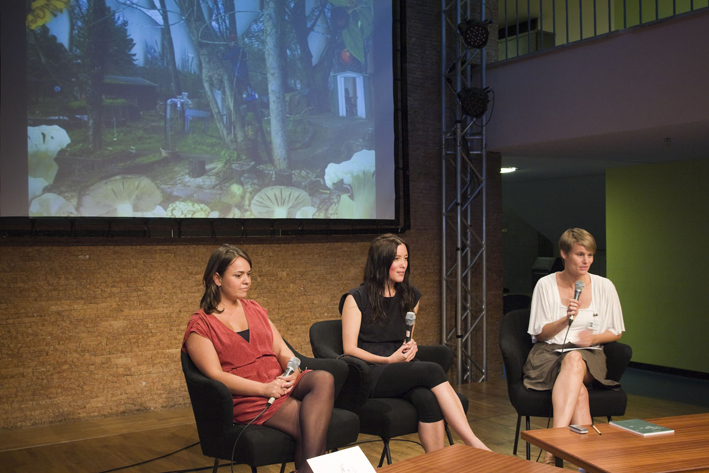
giulia giannola, gayle chong kwan, kirsten einfeldt

screening gayle chong kwan's assemblages

the audience

invisible twinning published by the green box

limited edition with inserts by artists gayle and giulia
See the book here: http://www.thegreenbox.net/en/books/invisible-twinning


All images: © Dante Busquets

venerdì 17 giugno 2011

48 Stunden Neukölln | Garten nr.3

Gayle Chong Kwan's, Potato, Collage, 2011
We have got card, paper, scissors and glue... join us and create your own ideal garden!

This weekend Invisible Twinning is attending 48 Stunden Neukölln and will create maquettes of ideal gardens. 
Everybody can partecipate! 
We are waiting for you!


Or do you have a secrete recipe to tell us? We will shot a video of you!

Hand in Hand, Rütlistr. 8, 12045 Berlin
Garden nr.3
Sa 18 Juni 14:00 — 20:00
So 19 Juni 12:00 — 18:00

program 2011 Hand in Hand

venerdì 20 maggio 2011

To make a great sataras...


To make a great sataras, add a spoon of Vegeta, Yugoslavian dried vegetables, and a spoon of fresh ajvar (a cream of roasted aubergines and peppers with chilli).

a bosnian recipe

Indeed I really love sataras, that is mixed vegetables, just vegetables. Moreover we use many of them for medicinal purposes: peppermint for instance and also roots, many different ones. Also parsley is used, it’s very good when dried to drink, it’s also good for the bladder. However when I am ill what makes me feel better it is just börek. We eat a lot but many different sorts, here it’s known just with cheese and meat, but we have it also with potatoes, pumpkin...

Almira-Ada Mesic, Bosnian, Gärten Rosenduft


Vegetables stew 
(sataras)

1 Kg red onions
1/2 Kg aubergines
1/2 Kg peppers
1Kg tomatoes

Cut the vegetables in little cubes.
First cook the onions in a pot with a little bit of oil.
Then put the aubergines and the peppers (roast them a little bit)
and after some minutes the tomatoes.
Add a little bit of water.
Cook for ca. 20 min then add pepper and salt.

lunedì 9 maggio 2011

I like to spend my time in the garden studying and playing music with my friends

Paulina with some friend playing music in her allotment

My father moved from Columbia to Berlin almost twenty years ago and we got the garden just two years after we applied for it.  We have a lot of beans over here, plus potatoes, carrots, cherries, basilicum, melissa and camomille. I like to spend my time in the garden studying and playing music with my friends even if we are the only ones our ages. The others usually are older, mostly my parents' age. They know and meet a lot of people here in the colony, though some can be a little bit conservative and a little strange with immigrants and homosexuals. Some of them are the ones with the German flag waving on their plot, but not all of them. The others are just proud to be Germans.
Anna Paulina Solano Miller, German-Columbian, POG, Bezirksverband Charlottenburg der Kleingärtner e.V.

lunedì 11 aprile 2011

Prinzessinnengarten


Other students and I with my family opened this place in July 2009. I wanted to become a father and have a job where I had not to work too much and could bring my kids with me. So, after living few years in Cuba, that has a very intense model of urban agricolture, I tried to do quite the same in Berlin. We cultivate all the different kind of vegetables you find in the supermarkets, but we use organic seeds to show our children how they grow and how better they are. Then we try to have a huge variety of kind for each vegetable. So we have 15 kinds of potatoes, 20 different kinds of tomatoes, 7 different kinds of carrots, 25 different kinds of ments, and some exotic things like 6 cm long beans from Africa. Some of the old women got cultural connections growing vegetables when they where young in Russia or Turkey or somewhere else. They have brought seeds or even plants with them from there, which they knew from their past, and which they wanted to have here as kind of piece of home. Many people have Turkish, Danish, French, American, English, Palestinian, Arabic, Indian, Swedish or Iraq ancestors. We have a very open system, so you do not have to become a member to partecipate.
Robert Shaw, British-German


In Germany we are not aloud to cultivate and sell herbs for medical purpose, so we do not cultivate any kind of these but we have got some things which are more for health. If you got a cough you can take a thyme tea or we have healing plants like comfrey.
Robert Shaw, English-German


Indigenuous people use some bushes for their health, but I do not know them. The same for our Chineses immigrants that have many traditional medicines using plants. However when I am sick I take fresh honey, ginger and garlic. They make me feel better.
Emma Rugg, Australian


We have rugbrød that is a very dark bread which is very healty because it is rich in whole grain and dietary fiber and contain little or no sugar, and is thus considered by many Danes as a healthy alternative to whiter types of bread. I never tried to bake it myself because it is a very long process, but my father does and it is always nice to come home and have the homemade smørrebred.

Ida Davidsen, Dane


I could find mangos in Berlin or kiwi from New Zeland, however they are not very fresh and it's not very good for the enviroment to buy foods that have been travelling half the world. So I do not like to buy them.
Emma Rugg, Australian


There is a popular Australian story that became a cartoon where a little koala - Blinky Bill - eats leaves from eucalyptus trees and these leaves have some medicinal benefits as his appendix can neutralise the toxins of the plants.
Emma Rugg, Australian

venerdì 1 aprile 2011

Cultivations at kga in Treptow

Bezirksverband der Gartenfreunde Berlin-Treptow e.V. from S-bahn

woman: You wanted to do some research... It’s best to arrange an appointment with Mr. Landgraf, he is here on tuesdays, but could you please call the office beforehand...

giulia: Can you help me with some general questions, please?
woman: I can only answer questions about plots, in terms of allocation.

giulia: Fine, what’s being cultivated in a plot?
woman: Plots are always being cultivated. Gardening is the key purpose of allotments. The main concern is cultivating fruits and vegetables. You need to grow fruits etc. for your personal use. However, as I said, Mr. Landgraf is the right person to speak to, he also works here, but is currently out of office. He is the Chairman of e.V. Treptow.

giulia: Do you also have an allotment?
woman: Yes of course, I have an allotment in Treptow.

giulia: And what do you cultivate?
woman: What do we cultivate... the majority makes potatoes, soft fruits, strawberries etc..


----------------------------


Ilona Gross: All herbs, basil, parsley, chives, marjoram, ground herb and as first thing green beans are inserted, green beens are made a lot. When they are inserted, it depends on how warm it is, end of April or beginning of May. Kohlrabi plants are grown with seeds in greenhouse, than the small plants are planted end of april, beginning of may. Tomatoes, carrots, all kind of vegetables, peppers, zucchini.

giulia: How are herbs used?
ilona: Yes herbs, for example, parsley for almost all dishes, and for soups, ground herb for green beans soup, it’s important.

giulia: Is there anything special for health?
ilona: Yes, garlic is for health.

giulia: Do you have your own parcel?
ilona: Yes I do.

giulia: What do you cultivate?
ilona: Everything I said, basil also as spice. And important is savory.

giulia: What is savory?
ilona: It smells like green beans, it’s very powerful, that must be used otherwise food doesn’t taste.


giulia: do you have a recipe?
ilona: I made a book actually. It has been made from women in the allotment garden unit Waldland.
It’s collected recipes.
Many allotment holder make themselves a spice garden, a raised bed, and there they make their spice garden. When they can not bend themselves anymore they make raised beds.

giulia: Asparagus time?
ilona: It’s always just until june, end of april until june. But asparagus is difficult to grow, just few gardners do it. Broccoli and cauliflower is the easiest. And what more…
Celery is very healthy, do you know celery? It’s round and black. And what we also make is salad with vinaigrette sauce, that is sweet sour spicy. Celery and also one makes beetroot, beetroot is very healthy. And they are also washed and cooked in salt and water and of course with sugar, vinegar, and pepper.

giulia: Why is it healthy?
ilona: Yes, for blood, hematopoiesis. One ha salso to read this again but I now from granny and my mom that this is healty.

giulia: Is there a tradition for vegetables in berlin?
ilona: Yes, pumpkin for example exactly, for soups, for kompottes, it is boiled down…

giulia: Kompotte?
ilona: Yes it’s called kompotte. Chopped Pumpkin , for dessert  or one can eat it with meat dishes or the pumpkin soup as appetizer, it’s very good. I give you my book as a present, here you see some dishes...

giulia: What is from you?
ilona: A lot, there is my name here, but these are collected recipes, that one can make also at home. For example  stuffed zucchini are made a lot, or vegetables onions, vegetable cake, stuffed kohlrabi...

giulia: Thank you very much!
ilona: Yes, with pleasure!