Town twinning between Berlin and other cities began with Los Angeles in 1967. East Berlin's partnerships were canceled at the time of German reunification and later partially reestablished. West Berlin's partnerships had previously been restricted to the borough level. During the Cold War era, the partnerships had reflected the different power blocs, with West Berlin partnering with capitals in the West, and East Berlin mostly partnering with cities from the Warsaw Pact.
Berlin is now twinned with 17 cities, mostly capitals expressing where Berlin thinks it should be aligned to, its equivalents.
However, looking at more invisible or unseen connections and 'lines of energy', we focus on unofficial twinnings, perhaps countries and cities that Berlin has a closer relationship to but prefers these to be more invisible, we are referring to twinnings which reflect Berlin’s current immigrant population.
In December 2008, 470051 residents (13.9% of the population) were of foreign nationality, originating from 195 different countries. An estimated 394000 citizens (11,7%) are descendants of international migrants and have either become naturalized German citizens or obtained citizenship by virtue of birth in Germany. The largest groups of foreign national are those from Turkey (111285), Poland (43700), Serbia (22251), Italy (14964), Russia (14915), the United States (14186), France (13113), Vietnam (12494), Croatia (10752), Bosnia and Herzegovina (10556), and the United Kingdom (10196). There is also a large Arab community, mostly from Palestine and Iraq, but there are no statistics about them, because they are often stateless.
These invisible twinnings an interesting starting point for connecting up with other places and countries and a way to analyze the idea of health in a wider sense, in terms of balance and imbalance, both on a societal and personal level and how people navigate and share resources within a city together between containment and borders.
The project Invisible Twinning investigates these themes looking at very specific German habit: in this country, indeed, there are more than one million small allotments (KGA) in the cities.Taken together, these have an area of more than 46000 hectares. The term “allotment” is determined by the § 1 of the Federal Allotment Act (BKleingG), which also defines the concept of the small garden use. The use of the allotment gardens is permitted in return for rental and resale price maintenance, in contrast to authentic weekend residences. Its definition is given in § 1 (Definitions) paragraph 1 No. 1 of the BKleinG. It reads:
"A small garden is a garden, that must serve the user (little gardner) for not commercial horticultural use (in particular for the production for own use) and for his recreation (kleingärtnerische use) [...]. "
The legislature recognises therefore as main use the collection of garden products and the recreational use. From this benchmark the so-called Third-System (Drittelregelung) has been developed. The allotment is to be used for one third as:
1st: Kitchen garden with vegetables, berries, shrubs, herbs, fruit trees, cold frame, compost, etc.
2nd: May be recreational garden with gazebo (max. 24 m²), terrace, lawn, seating, etc., with a maximum of 15% of the leased area sealed by plating.
3rd: Garden with perennials, ornamental shrubs, flower beds, hedges, etc.
The Third-System was however in a recent ruling by the Federal Court (BGH III ZR 281/03 of 17 June 2004) explicitly confirmed. The specific restrictions for the owners in relation to the amount of the rent and the termination options are justified primarily by the purpose of use of the garden cultivation. The rent for a small garden is set at four times the value of rent in commercial orchards. At 24 cents / m² it is significantly below the rent charged for weekend rentals and campgrounds.
This would also create the opportunity for people with lower incomes to find their own place in a natural surrounding, unfortunately, these allotments, that had taken on a special significance in West Berlin, where they represented precious patches of greenery in the walled city, even today they mostly belong to Berliners or German people.
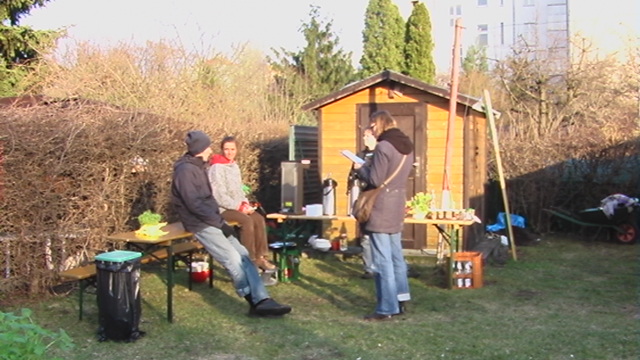
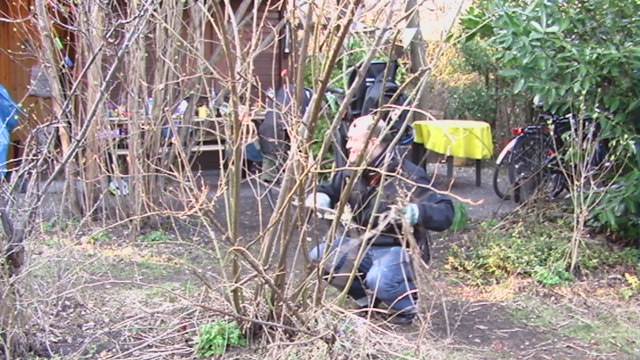
Looking at the specificity of Berlin's allotment system, the project Invisible Twinning work on a KGA where immigrants of different nationalities representing the percentages of immigration in Berlin can cultivate their own greenery. We set up plots for them to use for a certain number of months and ask each allotment holder to provide for or share a portion of their land for a given amount of time.
The project analyzes the rules that govern the allotment system and give the chance to people who have arrived from different countries to experience and experiment in them. The different plants, vegetables, fruits and herbs which would be grown there by a range of people would become a shared resource.
During project we will collect photographs, interviews, sketches, recipes, maps and stories providing information on herbs, fruit, vegetables or plants grown in the allotments, which have significance for the immigrant populations. The participants will be asked how they use different plants for health in their food, recipes for the ingredients they are growing, about the produce that they are not able to find in Germany that they miss, stories or tales associated with food and health, what "health" means to them, and their experiences of growing produce at the KGA. We will also look at plants that are already grown on the KGA, which may hold significance to the immigrant population as well as look at the countries of origin and global movement of plants, vegetables, and herbs, which are already grown in the allotments. We will also work with other allotment holders at KGA about their ideas of allocating land, the sharing of resources and the plants, vegetables, food and herbs that they grow for health and also what "health" means to them.
Different individuals and groups together with the artists will also be invited to run any sessions or workshops about growing, plants, vegetables, herbs, fruit and health, that others can attend throughout the project and help facilitate the access to and use of KGA plots for the different communities to grow food.
Project Outcomes
The documentation of all the activities and materials collected throughout the project will be developed as a small publication where one will find detailed aspects of the project as well as instructions and advice on growing such vegetables or plants in window boxes or small gardens together with written thoughts, found footage materials, historical connections and provenances reflecting ideas of balance and health, community and shared resources. The text will be written mainly in German, but also will be translated and in the different languages used by the immigrant populations. This will be distributed widely to project participants, KGA allotment holders, art galleries, garden centres, parks, and immigrant communities, as well as other appropriate places.
The project will culminate in a large-scale celebratory meal in which the plants, vegetables, fruit and herbs grown during the project will be prepared and cooked into a meal that references, but also alters the format of official state banquets or meals hosted for visiting dignitaries, an official unofficial meal celebrating and highlighting the countries and communities more closely twinned or connected to Berlin and Germany than the country’s official twinnings acknowledge. Project participants, KGA allotment holders and others interested in the project will be invited. The meal will be held in a public square in Berlin, close to the KGA allotments, linking up, crossing and traversing the borders between the separate plots of land.
A range of different people who have worked together on the project and who have not, will be invited to the meal, which may reference a historic or past ‘official’ banquet, such as a state visit by a visiting royal or president from the past to Germany, but will subvert and alter these aspects, through ingredients, format, recipes used and ways of presentation.
There will be an accompanying exhibition of photographic and video work created by the artists during the project, and some of the allotments involved may also be ‘open’ to visitors during the exhibition.