The project

Referring to the unofficial twinnings that reflect Berlin’s current immigrant population instead of the official equivalents of the city, the project explores the city’s long tradition of urban horticulture and reveals ideas of health in the widest sense: as balance and imbalance as well as on a societal and personal level, looking at how people navigate and share resources within a city.

martedì 20 settembre 2011

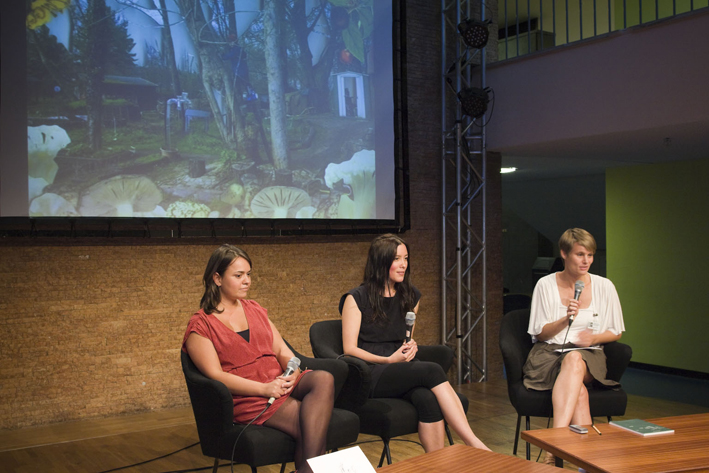
Book Launch at HKW | Sept. 6

giulia giannola, gayle chong kwan, kirsten einfeldt

screening gayle chong kwan's assemblages

the audience

invisible twinning published by the green box

limited edition with inserts by artists gayle and giulia
See the book here: http://www.thegreenbox.net/en/books/invisible-twinning


All images: © Dante Busquets

giovedì 15 settembre 2011

Cooking times at HKW

Cooking times, Giulia Giannola 2011


Kochzeiten, Cooking Times
A text by Francesca Mila Nemni

It is not just by chance that the word “time” appears in Giulia Giannola’ s latest work, “Kochzeiten (Cooking Times), eine Protraitserie.” Time is one of the key-concepts at the heart of this young Neapolitan artist’s research: she regards it as a crucial factor in contemporary societies, conditioning and even determining commercial, behavioral and relational exchanges.

These little videos, which call to our mind those Sunday morning TV programs on cooking, show some Berliners preparing food for their families. A Berliner, though, is not necessarily a German. Quite the contrary. So Giannola’s cooks prepare their food according to Turkish, Italian, Slavic, Chilean traditions… because today’s Berliners often come from more or less faraway countries.

Cooking and preparation times reveal differences in attitudes, habits, traditions. They reveal the personalities of the cooks. Some of them are very precise and professional, others prefer simple and quick preparations, and yet others believe that good food can’t be prepared in a hurry (feeling that haste is the enemy of good food). You can tell the “good mums,”  who spend most of their lives in the kitchen, from those cooking only for the big events. “Cooking Times” shows that food is an occasion for “sharing”: being together and taking taking care of each other—and oneself.

This story is told by the very people who cook their dishes while explaining the proper way to cut potatoes, and the best way to butter a pan. Some of their comments sound very detailed, some much less so. They “sound”, but we cannot be sure. That is because we face a babel of narrators’ voices, where each cook speaks his or her own language.

“Cooking Times” illustrates in a very simple way a normal condition in our contemporary life: a common condition of “superficial experiencing,” whereby on the one hand we are able to get in touch with many more cultures than in the past but, at the same time, we are denied access to any deeper knowledge. We all have tasted Italian, Oriental, Turkish dishes, but how many of us really know something about the places where these dishes come from? More to the point: how many of us are really interested in knowing them, or in speaking the languages of the people we are talking to?

Giulia Giannola’s videos show clearly that a meeting of cultures is going on- especially in big cities.  With the same clarity, they show how extremely superficial this meeting of cultures still is. We consume quickly.  We are more interested --because  it is easier— in eating an udon, than in knowing how it is made. This is the reason why no translation is needed.

A beautiful movie by Manuel De Oliveira -“Un filme falado”-   comes to mind. In it, every actor/actress was acting in his/her own language: French, Italian, Greek….A great meditation on intercultural communication. “Cooking Times” has no subtitles. Consequently, while on the one hand it suggests, (while at the same time denouncing) a superficial vision, on the other hand it could be the first step towards a project of deep intercultural communication. He who has ears to hear, let him hear.

giovedì 8 settembre 2011

Let's stay together at POG on Saturday at 7 pm


On Saturday September 10, there will be the closing reception of our project and we would really love to say thank you to all of you who join Invisible Twinning.
There will be a special meal performed by Gayle and some nice music during the evening. A really nice chance to stay together!

Join us here!

Bülowstrasse 68, at the Bülowbogen, you follow the U2 Bridge and arrive in the gardencolonie


http://www.wir-bleiben.de/impressum/

martedì 30 agosto 2011

Release of the book

We are delighted to announce the release of the book Invisible Twinning.

Book Launch: Tueday, 6 September, 6:30 pm at Haus der Kulturen der Welt, Café Global. The curator and artists will be present.


Published by The Green Box
Book design: Anja Lutz

Invisible Twinnig ist published as part of the program "Meridian Urban", Asia-Pacific-Weeks 2011 at the House of World Clultures in Berlin, 7–19 September, 2011.


40 pages, 24 colour illustrations
165 x 240 mm, softcover
English / German
ISBN 978-3-941644-29-8
Euro 12,—

domenica 21 agosto 2011

Bean | Phaseolus vulgaris, Fabaceae

Gayle Chong Kwan, Bean, collage, 2011

Beans are one of the longest-cultivated plant and are a very significant source of protein throughout the world as they have significant amounts of fibre andre. This can help lower blood cholesterol. Beans are also high in complex carbohydrates, folate and iron.


We cultivate all kinds of herbs, such as basil, parsley, chives, marjoram and savory, though mainly we plant French
beans. Ilona Gross, Waldland, Bezirksverband der Gartenfreunde Berlin-Treptow e.V.
 

Parsley is used in almost all dishes and for soups, whilst savory is essential for French bean soup. 
Ilona Gross, Waldland, Bezirksverband der Gartenfreunde Berlin-
Treptow e.V.


My father moved from Columbia to Berlin almost 20 years ago and we got the garden just two years after we applied for it. We have a lot of beans over here, plus herbs, carrots and basilicum. I like
to spend my time in the garden studying and playing music with my friends even if we are the only ones of our ages. The
others are mostly older, more of my parents’ age. They know and meet a lot of people here in the colony, though some can be a little bit conservative and a little strange with immigrants and
homosexuals. Some of them are the ones with the German flag waving on their plot, but not all of them. The others are
just proud to be German. 

Anna Paulina Solano Miller, POG, Bezirksverband Charlottenbu
rg der Kleingärtner e.V.
 

The garden opened in 2004 or 2005 but we got our little plot only last year. I had just had my baby and I had a lot of free time, so we decided to start cultivating. We have different kinds of
beans, strawberries, potatoes, beetroot and some herbs… All vegetables are healthy. It is great to have a green oasis
inside the city. I grew up in the suburbs of Berlin where there are a lot of green areas and I missed them. 

Hana Gunkel, Bürgergarten Laskerwiese e.V.
 

Japanese consider it very important to have 30 different kinds of food every day. The government encourages the nation to have lots of different foods, to keep a balance between vitamin C and proteins, carbohydrates and fat. I learnt at school that each food is
categorised into 5 or 6 groups, like fish or meat, or beans or milk, and the government says that having these different types of food everyday is ideal.
Miki Ito, Hand in Hand, Bezirksverband Berlin- Süden der Kleingärtner e.V.
 

When bean stew gets burnt, put the pan, with the lid on, in cold water for about 10 minutes. Then put the food in another pan and season accordingly.
Margrit Kissling, Waldland, Bezirksverband der Gartenfreunde Berlin-Treptow e.V.