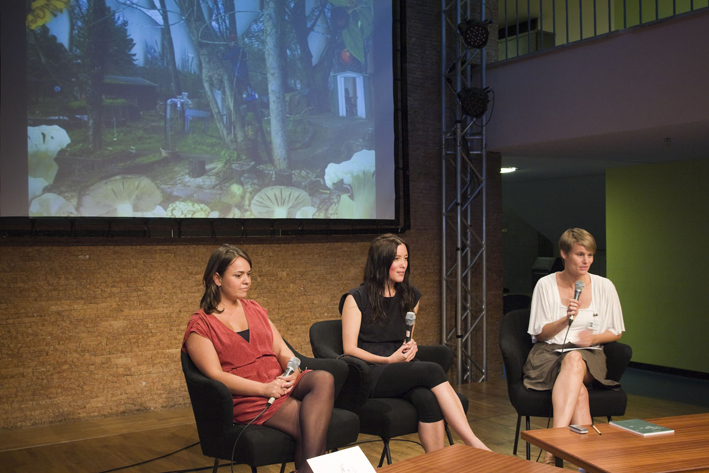
Meridian I Urban. Curatorial Projects on Health presents five projects by international up-and-coming curators on the subject of “Health.” The projects artistically map the urban space of Berlin, using health-related motifs and identifying relationships between health and the lives of their visitors: they offer opportunities for alternative participation and identification. At various locations in Berlin, which can be regarded as especially interesting, conflict-ridden or significant for a healthy, urban life, they bring to light social, historical and cultural peculiarities.
The project
Referring to the unofficial twinnings that reflect Berlin’s current immigrant population instead of the official equivalents of the city, the project explores the city’s long tradition of urban horticulture and reveals ideas of health in the widest sense: as balance and imbalance as well as on a societal and personal level, looking at how people navigate and share resources within a city.
Visualizzazione post con etichetta francesca mila nemni. Mostra tutti i post
lunedì 17 ottobre 2011
We, inside Meridian Urban publication
Meridian I Urban. Curatorial Projects on Health presents five projects by international up-and-coming curators on the subject of “Health.” The projects artistically map the urban space of Berlin, using health-related motifs and identifying relationships between health and the lives of their visitors: they offer opportunities for alternative participation and identification. At various locations in Berlin, which can be regarded as especially interesting, conflict-ridden or significant for a healthy, urban life, they bring to light social, historical and cultural peculiarities.
Etichette:
book,
buecher,
community garden,
francesca mila nemni,
gayle chong kwan,
giulia giannola,
Invisible Twinning,
Jaroslav Toussaint,
kunst,
Meridian I Urban,
revolver publishing,
Vanessa Enriquez
venerdì 7 ottobre 2011
Before the celebratory meal starts | Sept. 10
| gayle's photograph |
| ute, our great chef! |
| meal flowers |
| preparing the dinner |
| syroup |
| the first people arriving |
| the colourful meal |
![]() |
| noodles, courtesy dante busquets |
![]() |
| pasta, courtesy dante busquets |
![]() |
| flower cake, courtesy dante busquets |
| our talk |
![]() |
| overview |
![]() |
| tasting the food |
![]() |
| let's start! |
| thank you to all the people who join us! |
Etichette:
Berlin,
francesca mila nemni,
garden,
gayle chong kwan,
giulia giannola,
Haus der Kulturen der Welt,
Invisible Twinning,
meal,
POG,
synapse
martedì 20 settembre 2011
Book Launch at HKW | Sept. 6
![]() |
| giulia giannola, gayle chong kwan, kirsten einfeldt |
![]() |
| screening gayle chong kwan's assemblages |
![]() |
| the audience |
![]() |
| invisible twinning published by the green box |
![]() |
| limited edition with inserts by artists gayle and giulia |
giovedì 15 settembre 2011
Cooking times at HKW
| Cooking times, Giulia Giannola 2011 |
| Cooking times, Giulia Giannola 2011 |
Kochzeiten, Cooking Times
A text by Francesca Mila Nemni
It is not just by chance that the word “time” appears in Giulia Giannola’ s latest work, “Kochzeiten (Cooking Times), eine Protraitserie.” Time is one of the key-concepts at the heart of this young Neapolitan artist’s research: she regards it as a crucial factor in contemporary societies, conditioning and even determining commercial, behavioral and relational exchanges.
These little videos, which call to our mind those Sunday morning TV programs on cooking, show some Berliners preparing food for their families. A Berliner, though, is not necessarily a German. Quite the contrary. So Giannola’s cooks prepare their food according to Turkish, Italian, Slavic, Chilean traditions… because today’s Berliners often come from more or less faraway countries.
Cooking and preparation times reveal differences in attitudes, habits, traditions. They reveal the personalities of the cooks. Some of them are very precise and professional, others prefer simple and quick preparations, and yet others believe that good food can’t be prepared in a hurry (feeling that haste is the enemy of good food). You can tell the “good mums,” who spend most of their lives in the kitchen, from those cooking only for the big events. “Cooking Times” shows that food is an occasion for “sharing”: being together and taking taking care of each other—and oneself.
This story is told by the very people who cook their dishes while explaining the proper way to cut potatoes, and the best way to butter a pan. Some of their comments sound very detailed, some much less so. They “sound”, but we cannot be sure. That is because we face a babel of narrators’ voices, where each cook speaks his or her own language.
“Cooking Times” illustrates in a very simple way a normal condition in our contemporary life: a common condition of “superficial experiencing,” whereby on the one hand we are able to get in touch with many more cultures than in the past but, at the same time, we are denied access to any deeper knowledge. We all have tasted Italian, Oriental, Turkish dishes, but how many of us really know something about the places where these dishes come from? More to the point: how many of us are really interested in knowing them, or in speaking the languages of the people we are talking to?
Giulia Giannola’s videos show clearly that a meeting of cultures is going on- especially in big cities. With the same clarity, they show how extremely superficial this meeting of cultures still is. We consume quickly. We are more interested --because it is easier— in eating an udon, than in knowing how it is made. This is the reason why no translation is needed.
A beautiful movie by Manuel De Oliveira -“Un filme falado”- comes to mind. In it, every actor/actress was acting in his/her own language: French, Italian, Greek….A great meditation on intercultural communication. “Cooking Times” has no subtitles. Consequently, while on the one hand it suggests, (while at the same time denouncing) a superficial vision, on the other hand it could be the first step towards a project of deep intercultural communication. He who has ears to hear, let him hear.
martedì 30 agosto 2011
Release of the book
We are delighted to announce the release of the book Invisible Twinning.
Book Launch: Tueday, 6 September, 6:30 pm at Haus der Kulturen der Welt, Café Global. The curator and artists will be present.
Published by The Green Box
Book design: Anja Lutz
Invisible Twinnig ist published as part of the program "Meridian Urban", Asia-Pacific-Weeks 2011 at the House of World Clultures in Berlin, 7–19 September, 2011.
40 pages, 24 colour illustrations
165 x 240 mm, softcover
English / German
ISBN 978-3-941644-29-8
Euro 12,—
Etichette:
allotment system,
anja lutz,
Asia-Pacific week,
Berlin,
english,
francesca mila nemni,
gayle chong kwan,
German,
giulia giannola,
green box,
health,
Invisible Twinning,
KGA,
Meridian I Urban
giovedì 23 giugno 2011
Invisible Twinning tree at Hand in Hand
| inside the garden house, too much rain outside |
| rita and thomas busse, the nicest gardeners ever! |
| gayle installing her apple tree |
| writing memories on food |
| paprika |
| creating an ideal garden |
| the outcome |
| giulia giannola, Kochzeiten (Cooking Times), video installation |
| Kochzeiten (Cooking Times), video installation, Parzelle 3, Hand in Hand |
| enjoying the installation tree |
| a german must: kohlrabi! |
| gayle explaining Invisible Twinning project |
| Invisible Twinning tree, Parzelle 3, Hand in Hand |
Etichette:
48 Stunden Neukölln,
apfel,
francesca mila nemni,
garden,
gayle chong kwan,
German,
giulia giannola,
hand in hand,
Haus der Kulturen der Welt,
Kochzeiten (Cooking Times),
Kohlrabi,
paprika,
parzelle
lunedì 28 marzo 2011
who we are | the invisibles
Etichette:
Berlin,
francesca mila nemni,
gayle chong kwan,
giulia giannola,
Haus der Kulturen der Welt,
Invisible Twinning,
Meridian I Urban
lunedì 21 marzo 2011
Etichette:
Berlin,
food,
francesca mila nemni,
gayle chong kwan,
Gesundheit,
giulia giannola,
Haus der Kulturen der Welt,
health,
Heimat,
Invisible Twinning,
Meridian I Urban
giovedì 10 marzo 2011
Invisible Twinning @ 48 Stunden Neukölln - 18/19 Juni 2011
Etichette:
18/19 juni,
48 Stunden Neukölln,
francesca mila nemni,
gayle chong kwan,
giulia giannola,
hand in hand,
interkulturelle,
Invisible Twinning,
Kleingartenanlage,
multikultur
martedì 8 marzo 2011
Etichette:
Berlin,
francesca mila nemni,
gayle chong kwan,
Gesundheit,
giulia giannola,
health,
Immigrationshintergrund,
Invisible Twinning,
kolonie
mercoledì 16 febbraio 2011
Susi Butscher | Ton Steine Gaerten
| Gayle going to Ton Steine garden |
It was like the first summer last year so it was like making our experiences. They started out last year around this time, I think I joined in April. I saw the garden, then in March I asked to participate and they had a little plot for me. Mine is the one on the corner with the table.
| Allotments at Ton Steine garden |
Now we are full, there’s no free plots left and but in the beginning it was like whoever came just like they should accept that it is more of a group things than an individual, like ‘Its my land and I will not talk to anybody.’ So it’s a really mixed group, a really mixed group, we didn’t expect it to be like this.
Turkish people, because a lot of Turkish people live here, but like even old Turkish people who do not speak a lot of German, and some, I don’t know where in Africa, but some. The Turkish women always have a Samovar and during the summer time they make like a picnic and serve tea to the others.
There’s one Turkish thing, I dont know the name, because its like kohl, cauliflower, but its only the leaf, not the whole head, that’s something that is typically Turkish and they are happy because that is something that you cannot buy here. But then there’s one of the African guys, then he was really happy too because he knew the same plant. So they are connecting in some way. They make like what you usually make with vine leaves, but they do not take the vine leaves, but this thing.
| Gayle and Susi talking |
| Different ways of fencing |
| the Turkish corner |
However we didn’t expect it to be like this much, because we had these tomatoes there by the corner of the side walk and they were like phswww, gone, so well the local government did not want us to put fences because they say it’s a public space. But still we want it for the dogs because the dogs come, you know people walk with their dogs, the dogs run in, so I think we will work on this, so at least we have a little door so that the dogs cannot come in.
| Ton Steine overview |
There’s a Spanish girl who asked to put a recipe on the wall, and its what we did, and we cooked this recipe. She says that she did this all over the world, especially to make people, when there are ethnic tensions, to make people think, to make people more in contact with other ethnics. The ingredients were grown from here, but we do not have eggplants.
http://gaerten-am-mariannenplatz.blogspot.com/
![]() |
| the recipe |
Etichette:
Berlin,
community garden,
francesca mila nemni,
garden,
gayle chong kwan,
giulia giannola,
ingredient,
mariannenplatz,
parzelle,
recipe,
susi butscher,
ton steine,
turkish,
vegetable
Iscriviti a:
Post (Atom)